Sunday, December 18, 2016

Celebrity and TPAB

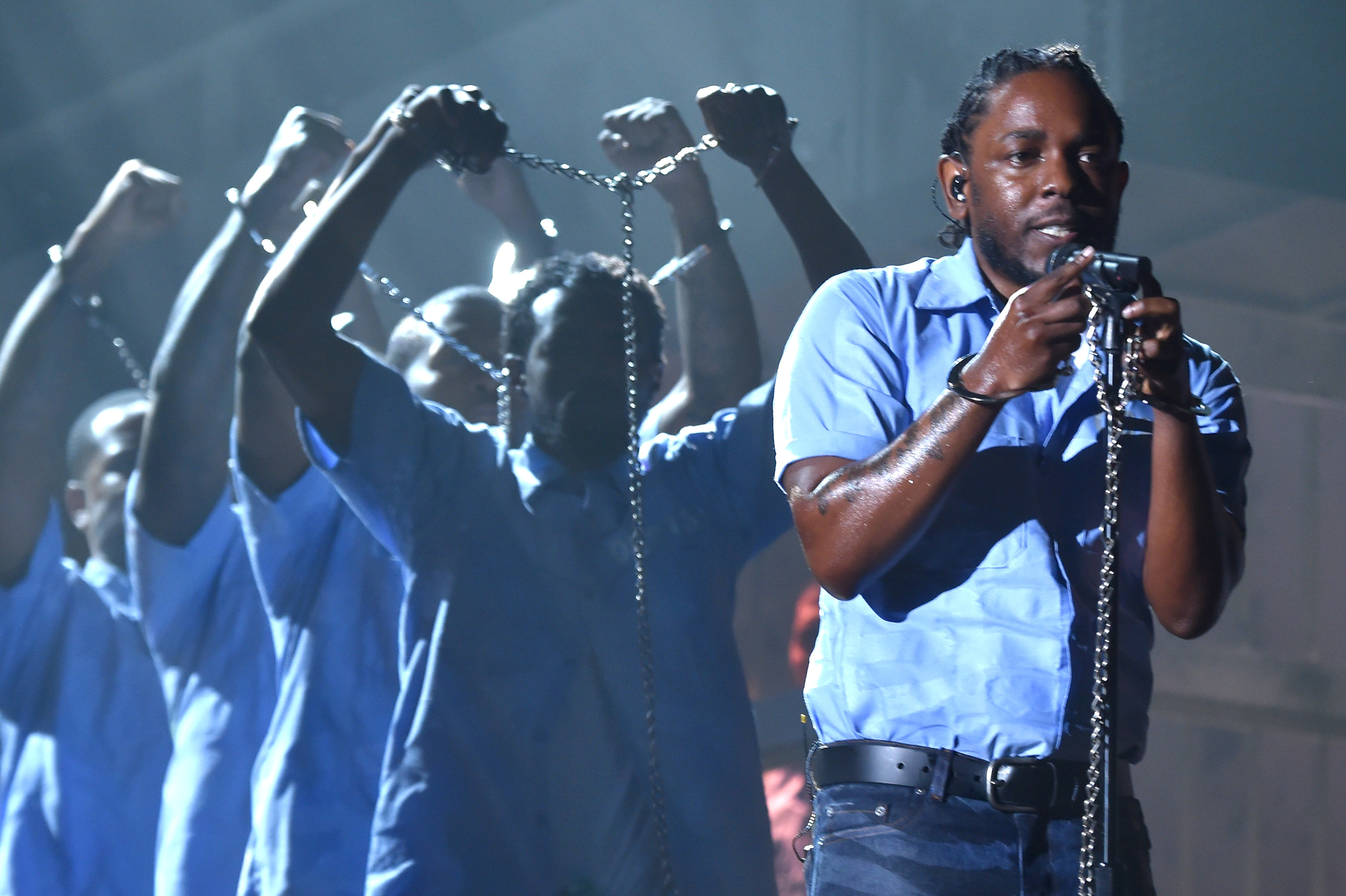
Kendrick Lamar, the artist behind TPAB, is not a materialistic or flashy individual. He is not the cliched celebrity or rap superstar that your normally see, with the gleaming jewelry, supermodel girlfriend, and the newest car. He is a humble being, who sticks to his roots and is rarely seen in the limelight. He has had the same girlfriend since high school, and according to the Huffington Post, Lamar has recently bought a modest $524,000 Californian home with his wife. On social media, he hardly posts anything, unless it's promoting his or his fellow Top Dawg Entertainment's artists projects. You can visualize his unpretentious background through his music, especially with "To Pimp a Butterfly."
Below is a video from Complex magazine about his recent purchase.


His first and introduction song on TPAB is a song called "Wesley's Theory." This song displays Lamar's awareness of the power of celebrity and fame, and how it can all go wrong if you do not have the proper education or understanding of finances and economics. I've discussed this song in the last blog about race, and this song can be used while discussing various circumstances, including celebrity. This track is has two main verses, the first about a celebrity who just came across his first big check and how he is going to spend the fortune he has recently come across. The next verse, displays capitalist America, and how they will deceive this celebrity into buying all these things until he becomes broke. Many celebrities are unaware of this reality, and continue to spend their money on impulse without any thought. Luckily, Kendrick Lamar understands that this happens to various individuals, and this song can hopefully bring awareness to this and can make celebrities more aware of their finances.

Another song that sways from the generic superstar's message is "How Much a Dollar Cost," which appears 11th on the album. Up until this song, Kendrick has discussed his celebrity, and the royalties he has received because of his fame, and how their are certain aspects of the music industry that could cause harm or make you lose that fame and fortune. This song is about a homeless man in South African gas station who asks for 10 rand (approximately 1 U.S. dollar) and from everything Kendrick has told his fans through this album, he has a hard time giving a dollar away because he has went through and worked so hard for his money. This selfishness that he has becomes apparent as the discussion goes further with the homeless man, and he becomes aware of this selfishness after this man reveals himself to be God. This hypothetical situation that Kendrick tells through this song, exhibits his humanity and humbleness. Attributes that are hard to find in many celebrities.




Sunday, December 4, 2016

Race within TPAB

Hip-hop musicians use their musical platform to address various issues. One topic that has been tackled by countless artists is the subject of race. Race goes hand-in-hand with hip-hop; from Tupac Shakur addressing the struggle of growing up in a primarily African-American community to Eminem discussing being white in a music genre that is mostly dominated by black artists. Kendrick Lamar's "To Pimp a Butterfly," did not sway away from confronting race, actually almost every song discussed race, racism, and prejudice.

One song in particular in TPAB that addresses race is called "Wesley's Theory." The title is based on the actor Wesley Snipes, and his notorious problems with tax evasion. There is two main verses in the song, the first is from an African American entertainer's perspective. Many musicians, athletes, and other famous individual's rise to fame and fortune quickly. They obtain an immense amount of money in a short time, and many of them forget to educate themselves on finances before they spend that money. In the first verse of "Wesley's Theory," Kendrick Lamar raps about being "uneducated black male" but receiving a "million dollar check." The second verse is from a different perspective, it's from the view of white capitalist America, epitomized by Uncle Sam. "Uncle Sam" tells this entertainer that you can buy anything you want without consequences, then tells him to remember that "he didn't pass economics in school" and that he will "Wesley Snipes him before he turns thirty-five," meaning that he will be arrested for tax evasion in no time. Lamar wants to let black entertainers that the music industry is eager to fool them.

A song in TPAB that has been regarded as a "new black national anthem" is the empowering song "Alright." The hook is from the music powerhouse "Pharrell Williams as he states, "We gon be alright." Many activists used this song as a rebuttal against racism and police brutality. The activists wanted it to be let known that no matter how unjust that they feel, they will unify in solidarity and overcome the injustices, and be okay. Another song from TPAB that had similar responses from the public is "i." "i" is a song that is about self-love. Kendrick has been through a lot, growing up in Compton, a dangerous and low-income community, and overcoming various obstacles to becoming one of the best known musicians of today. This song celebrates overcoming obstacles, like police brutality and racism.


Kendrick Lamar uses his platform better than most artists. When countless artists use their platform to talk about money, guns, and women, Kendrick sways from the "norm" in hip-hop and tackles social issues and wants his fans to be aware of what is going in society. He is an extraordinary artist and has already made his mark in music history, and there is only more to come from the visionary.


Thursday, November 10, 2016

Blog Entry 3: Feminism within TPAB

Women are oppressed on countless occasions in hip-hop. Throughout the years, rappers and musicians have called women derogatory remarks and other vulgar obscenities. Feminism does not really have much of an affect in regards of rapper's today. However, Kendrick Lamar, as I stated in the previous blogs, is not like all rappers. He is an activist, a visionary, among other things. He stands up for the unspoken, and will address issues that others do not. That does not mean he is a saint; he has said things about women that I can not address in this post. But, I believe he grew as a musician and a human-being with the creation of To Pimp a Butterfly. In this album, he addresses social issues such as feminism.


One song that come to my mind when I think of feminism in regards To Pimp a Butterfly, is the song "Complexion (A Zulu Love.) This song is about educating society on colorism, and he features a lesser known female artist, Rapsody, on this song and she discusses her experiences of being a woman of color in the United States. The first part of this song Kendrick says, "Dark as the midnight hour or bright as the mornin' sun, give a (explicit) about your complexion..." I believe that he is speaking about women in this part of the song, and he doesn't care what shade of black or what shade of any color you are, Lamar still appreciates you and thinks you are beautiful. Another lyric in this song that struck me as very empowering to women and the feminism movement is this: "Beauty is what you make it, I used to be so mistaken, by different shades of faces, then Whit told me, a woman is a woman, love the creation, it all came from God then you was my confirmation." This lyric in particular, shows how much Lamar grew from a young rapper talking about money to an artist discussing God and the beauty of women. 

In many of his songs, some of the things he says can go over a listener's head. He discusses "Complexion" in particular in an interview and discusses the origins of  it. He states, "The idea was to make a record that reflected all complexions of black women. There's a separation between the light and the dark skin because it's in our nature to do so, bur we're all black. This concept came from South Africa and I saw all these different colors speaking a beautiful language." I think it's spectacular for an artist to stand-up and make a song like this, and address issues and subjects that others typically do not.

There are various other songs as Lamar has grown where he discusses the empowerment of women, including "These Walls," "Sing about me," "Momma," among others. He is truly trying to use his platform as a way to communicate political and social issues that many are not aware about, including the feminist movement. As he continues to grow as an individual and an artist, I believe his fan will see even more ways that Lamar will address the empowerment of women and feminism. 

Below is a video with Lamar and a huge figure in the feminist movement, Beyonce.


Sunday, October 23, 2016

Blog Entry 2: Political Economy of TPAB

There are various elements that it takes to make a superb hip-hop album. First, you usually need to have a plethora of unique artists and producers to come together to add components to make the album or a particular song come together smoothly. "To Pimp a Butterfly" certainly did just that. It took 71 artists, songwriters, and producers to create this artifact. From the music power-house Pharrell Williams to the great Ronald Isley, Kendrick Lamar did not limit this album to just one category. Lamar put together rappers, drummers, keyboardists, saxophonists, and more to construct this masterpiece. The thought and time that it took Lamar and others to put all this talent together is just incredible. However, it was certainly worth it. TPAB was nominated for 11 Grammy Awards, which is just one behind the "King of Pop" himself, Michael Jackson. Here is a video of Kendrick explaining why he is glad that he didn't surpass the all-time great.

The recording of this album started only about a week after Lamar released his sophomore album, Good Kid M.A.A.D City, in 2012. The album was recorded throughout various studios in the United States. Lamar traveled to different locations to work with some of the more prominent artists on the album including the "Funkadelic" George Clinton. Lamar discussed in an interview with Grammy.com on how he got in touch with Clinton. He stated, "I had to find George Clinton in the woods, man. He was somewhere in the south and I had to fly out to him. We got into the studio and just clicked." Sounwave, a prominent producer who worked on various songs for TPAB, explained in an interview with MTV on how all the contributors of the album had to be in-person to record. He stated, "The whole process of the album is you literally had to be in the studio with us to get the sound we're trying to portray."
In order to release TPAB to the masses, Lamar had to work with record labels and a recording company. The two labels that TPAB was released by were Top Dawg Entertainment (TDE) and Dr Dre's Aftermath Entertainment. Top Dog Entertainment is an independent record label founded by Anthony "Top Dawg" Tiffith. Tiffith and Lamar have been working with each other since Lamar was fifteen-years-old. Top Dawg Entertainment gained prominence with the continuing success of Lamar's career and the few others artists on the label that include: ScHoolboy Q, Ab-Soul, Jay Rock, Isaiah Rashad, and SZA.

TPAB was released by two labels because Top Dawg Entertainment does not have full ownership of their products. The label signed a joint-venture deal with Aftermath Entertainment and Interscope Records in 2012. TPAB was jointly released by Top Dawg Entertainment, Aftermath Entertainment, and Interscope Records on March 15th, 2015. The album was intended to be released on March 23rd of that year, however it was released a few days earlier because of an error from the recording company, Interscope Records, which is also the distributor for Top Dog Entertainment. Interscope Records and Aftermath Entertainment are massive in the music world and share the same distributors, which are Interscope Geffen A&M and Universal Music Group.
The only dispute that I found regarding TPAB was the initial release date that I stated earlier. It took me awhile to research all the elements that it took to create this album, and I found it pretty amazing how somehow it all came together to become such a prominent artifact.


Work Cited:

Andreas, Hale. "The Oral History Of Kendrick Lamar's To Pimp A Butterfly." The GRAMMYs. N.p., n.d. Web. 23 Oct. 2016.

Fleischer, Adam. "Kendrick Lamar's TPAB Producers Take You Inside The Studio: 12 Things We Learned." News. N.p., 30 Apr. 2015. Web. 23 Oct. 2016.

Nguyen, Hao. Stop The Breaks Independent Music Grind. N.p., 27 Aug. 2015. Web. 23 Oct. 2016.


Monday, October 3, 2016

Blog Entry 1: Everything I know about TPAB


On March 15th, 2015, Kendrick Lamar blessed fans worldwide with the release of his third studio album titled "To Pimp a Butterfly." "To Pimp a Butterfly," or simply TPAB, is a roller-coaster of an album that overwhelmed fans as it covered everything from Lamar's depression to racial inequality in the United States. The album revealed emotions from the artist that have never been exhibited before, and the lyrics displayed the growth of Lamar as an artist and individual.
Prior to the release of TPAB, Lamar released two singles from the album, the uplifting, joyous,"i," that contains a sample of The Isley Brother's hit song, "That Lady," and the more grim, dark single, "The Blacker the Berry." These two polar opposites of songs made fans, including myself, clueless and skeptical on the direction that Lamar was taking with this album.
The morning of the release of TPAB, I was beyond excited to go on the streaming service, Spotify, and listen to Lamar's full album. I researched various reviews, and many of favorite music journalists praised the album for its sincerity and profound lyrics. I had to listen to the album a few times to give my take because it certainly did overwhelm me like it did to many fans. However, after a few listens I comprehended the meaning that Lamar wanted to convey, and it soon became my favorite album of all time.
I've been a fan of Kendrick Lamar since 2009. when he released his debut extended play (EP) titled "The Kendrick Lamar EP." As a fan of the more lyrical era of hip-hop, the 1990s, Lamar impressed me with his clever flow and rhyme-scheme. He was a lyrical genius, and I quickly knew that he was going to leave a prominent mark in hip-hop. Lamar quickly rose through the ranks and became the spearhead of hip hop's new era. With his first two studio albums, "Section.8o" and "good kid, m.A.Ad city," gaining praise from some of the hip-hop greats, Lamar was certainly on the rise and becoming the next big thing. TPAB only cemented his reign, and in my opinion put him up with the all-time greats of not only just hip-hop, but music in general.
The way the album was put together was just remarkable, and the story that it transmitted was unbelievable. He also recorded the album with a live band, while most hip-hop artists would be terrified and unable to accomplish such a feat. Lamar rapped and sang over these various musical instruments with poise, and brought various musicians together who are completely unrelated to hip-hop and put them in his songs perfectly.
While many hip-hop artists today gained their fame with elementary lyrics that show almost no real skill or talent, and sway many people away from listening to hip-hop, Kendrick Lamar's genius is here to save hip-hop from becoming a travesty of what it once was. As an artist and activist, Kendrick Lamar addresses issues that many want to push under the rug, especially with TPAB. The artifact, TPAB, will leave a lasting mark on music and society alike for a long time.